
Tiny Trail Kids • November 26, 2026 • 12
Why Do One-Piece Children’s Costumes (Racer, Pilot, Astronaut) Feel Short in the Torso? Choosing a Size Based on Torso Length, Not Age

When you decide to order a one-piece racer jumpsuit, pilot flight suit, astronaut costume, or fleece animal onesie for your child’s 1st birthday “Fast One,” 2nd birthday “Two Fast,” or aviation/space-themed birthday party, the most important question you face is choosing the right size. Many parents who are used to shopping for everyday T-shirts or sweatpants by looking only at the age label (for example, “2 Years” or “4 Years”) sometimes encounter a surprising situation with one-piece jumpsuit / onesie costumes: “The sleeves and legs of the jumpsuit fit my child perfectly, and the legs are even slightly long; but when my child crouches down or raises their arms, the crotch of the jumpsuit pulls upward and tightens across the shoulders!” Or, conversely, “We bought one size larger according to their height, but this time the crotch dropped all the way to their knees!”
In children’s garment pattern engineering, one-piece jumpsuits are subject to an anatomical rule that is completely different from two-piece outfits. With a two-piece outfit, you can move the elastic waistband of the trousers 2 centimeters up or down to adjust it to the child’s torso length; however, in a one-piece jumpsuit, the distance from the shoulder seam to the crotch seam between the legs is fixed. Two children of the same age and the same total height (for example, 98 cm tall) may differ: one may have long legs and a short torso, while the other may have a longer torso and shorter legs. That is why the secret to a perfect fit in one-piece costume jumpsuits is choosing the size based not on age, but on Torso Length (Shoulder to Crotch / Torso Measurement).
As the Tiny Trail Kids workshop, in this comprehensive sizing and pattern guide, we explain step by step why crotch length is critical in our one-piece styles such as the Personalized Red Race Car Jumpsuit, Green Pilot Flight Suit, White Astronaut Space Jumpsuit, and Fleece Bunny Onesie, how to take an accurate torso measurement at home with a measuring tape in 30 seconds, and how to calculate diaper allowance for babies who wear diapers.
1. Why Is “Crotch Length” (Shoulder-to-Crotch Distance) the Most Critical Measurement in Children’s One-Piece Jumpsuits?
A child never stands perfectly upright like a display mannequin at a birthday party or during playtime; they run after balloons, sit cross-legged on the floor to open presents, slide down slides, and get picked up. A jumpsuit that appears to fit perfectly while the child is standing upright needs approximately 4 to 6 centimeters of additional stretch allowance (movement ease) around the back and hip area when the child crouches or bends down.
- What Happens If the Torso/Crotch Length Is Too Short? If the torso measurement from the shoulder to the crotch is exactly the same as your child’s own torso measurement (with no movement allowance), there may be no problem while the child is standing, but as soon as they bend their knees to sit, the fabric across the back of the jumpsuit becomes taut, pulls the shoulders downward, and presses the crotch seam between the legs. As soon as the child feels this tension, they become uncomfortable and want to take the costume off.
- Why Are Sleeve and Leg Lengths Easier to Adjust Than Torso Length? The torso/crotch length of a one-piece jumpsuit cannot be lengthened later; however, if the sleeves or legs of a jumpsuit with a comfortable torso length are 2–3 centimeters too long, you can adjust them to the perfect length within seconds by folding the cuffs or hems inward or outward by one turn. Therefore, our golden rule is: When choosing a jumpsuit, always use the leg length as a secondary reference and prioritize the torso (shoulder-to-crotch) length!

2. The Often-Forgotten Detail for Babies Who Wear Diapers (Ages 1 and 2): “Diaper Allowance”
Especially for families ordering the 1st Birthday Green Aviator Pilot Jumpsuit, Red Racing Jumpsuit with Yellow Piping, or White Short-Sleeve Racing Romper for 1st birthday (“Fast One” / “Top One” / “First Trip Around the Sun”) and 2nd birthday (“Two Fast”) celebrations, the factor most often overlooked is the volume taken up by the diaper.
When you measure your baby’s height in the morning without a diaper or while wearing a thin diaper, the torso measurement will be shorter. However, during a birthday party, as the baby drinks water and fruit juice, the diaper swells and creates at least 3 to 4 centimeters of additional volume (curvature) in the crotch area. If you choose a jumpsuit that is right at the size limit, a full diaper completely fills the crotch area and pulls the torso upward when you zip up the jumpsuit.
Solution: When measuring the torso (shoulder-to-crotch) length for babies aged 12–24 months and 2–3 years who wear diapers, be sure to measure while your baby is wearing a diaper (or over a jumpsuit they already own) and leave at least 3–4 cm of ease for comfortable movement.
3. How to Measure for a Jumpsuit at Home in 30 Seconds Without a Margin of Error (2 Practical Methods)
When ordering a personalized jumpsuit online, embroidered with your child’s name and birthday age, there are two simple measuring methods that completely eliminate the stress of wondering, “Will it be too tight or too large?”
Method 1: Measuring the “Shoulder–Crotch” Length on Your Child with a Measuring Tape
It can sometimes be difficult to keep an active child still while taking measurements, but measuring these three points takes only 30 seconds:
- Torso / Crotch Length (Saddle / Torso Length): Place the measuring tape at the top shoulder seam point next to your child’s neck. Run the tape straight down over the chest, between the legs (over the diaper if your child wears one), and to the exact midpoint between the legs (or, by folding the tape in half, to the back shoulder point). This one-way vertical distance from the shoulder to the crotch (Chest + Crotch Height) is the most vital measurement for preventing the jumpsuit from pulling on your child.
- Total Height (Top of Head to Heel): Have your child stand barefoot in front of a straight wall, place a flat book on top of their head, mark the wall, and measure the height from the floor.
- Chest Circumference: Wrap the measuring tape just below the armpits and around the fullest part of the chest without pulling it too tightly, leaving enough room for one finger to fit underneath.
Method 2: Measuring a Jumpsuit Your Child Currently Finds Most Comfortable on a Table (The Most Reliable Method!)
If your child will not stay still while being measured, do not worry! Take a jumpsuit from your child’s wardrobe that currently fits most comfortably and allows them to crouch and run freely (or place their top T-shirt and sweatpants on top of each other), and lay it flat on a table:
- Measure the distance on the garment from the highest point of the shoulder seam to the point where the crotch seams between the legs intersect, using a ruler or measuring tape held straight.
- Measure the front chest width from one armpit to the other.
- Note the sleeve length from shoulder to wrist and the total jumpsuit length from shoulder to ankle.
When you compare these four measurements with the size chart on our product page (or send them to our workshop in your order notes), your jumpsuit will fit your child as perfectly as if it had been tailored and fitted specifically for them.

4. Which Size Should You Choose When You Are Between Two Sizes? (The Advantage of Foldable Cuffs and an Elastic Waistband)
You have taken your child’s measurements and, for example, their total height fits a size 3T perfectly, while their chest circumference or torso (shoulder-to-crotch) length is at the upper limit of size 3T and very close to size 4T. In this situation, you should choose the next size up (4T) without hesitation. Why?
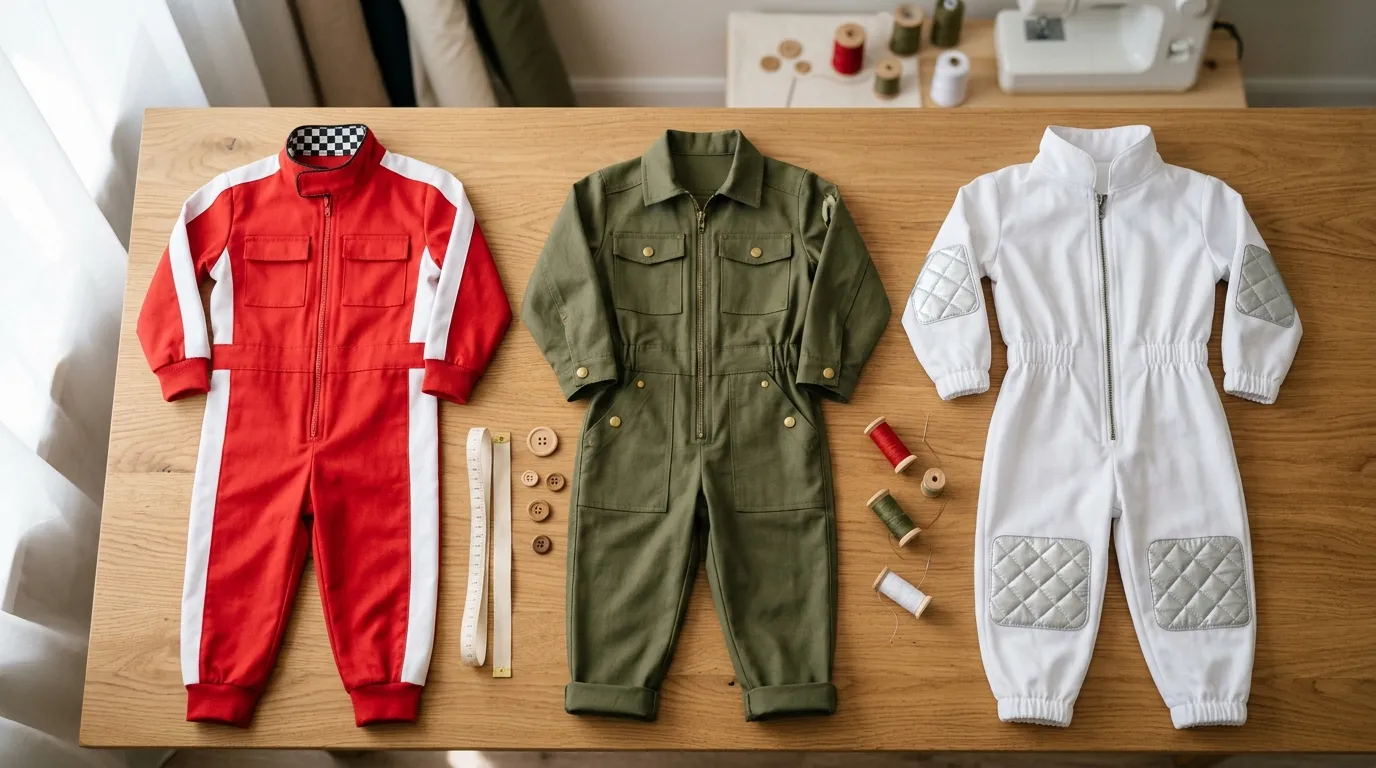
- The Back Elastic Waistband Shapes the Torso: The flexible waist belt and gathered back elastic at the waist of our Black-and-White Racing Jumpsuit with Turquoise Piping, Black Racing Driver Jumpsuit with Red Piping, and Khaki Green Pilot Flight Suit prevent a jumpsuit bought one size larger from looking loose and sack-like at the waist. They gently shape the jumpsuit to the child’s waist while leaving excellent room for movement in the crotch area.
- Ribbed and Foldable Sleeve/Leg Cuffs: In designs such as our White Astronaut Space Jumpsuit and Fleece Chameleon Jumpsuit, soft ribbed wrist cuffs or neat leg finishes gather even 3–4 centimeters of extra length at the wrists or ankles and sit stylishly over the shoes. As your child grows over the next 6–8 months, you can unfold the cuffs and continue using the same costume for Halloween, school career days, and playtime at home.
5. Calculating Layering Allowance Inside a Jumpsuit for Summer and Winter
The temperature of the venue where the party or event will take place should also be considered when choosing a jumpsuit size:
- Fall/Winter and Outdoor Parties: If the birthday or outdoor event will take place in cool weather and you plan to dress your child in a long-sleeve thermal layer, cotton bodysuit, and tights underneath the Long-Sleeve Red Racing Jumpsuit or Long-Sleeve Green Pilot Jumpsuit, these inner layers will take up approximately 1.5–2 cm of the jumpsuit’s interior volume. For winter layering, always choose the roomier size to preserve freedom of movement.
- Spring/Summer and Warm Indoor Parties: For summer birthdays, beach celebrations, or garden parties, our Red Short-Sleeve Racing Romper, Green Short-Sleeve Pilot Romper, and White Short-Sleeve Astronaut Romper models can be worn directly as a single layer. Since they have no leg-length limitation, they can be worn much longer during a child’s growth period and provide a perfect fit in the child’s true size.
6. Frequently Asked Questions (FAQ)
My child is heavier than their peers, with a tummy, but their height is standard. How should I choose a size?
For stockier children or children with a tummy, the width around the chest and abdomen directly affects the crotch length as well, because the fabric is pulled upward vertically as it wraps around the tummy. Therefore, if your child’s chest or waist circumference is above the measurements for their age, the best solution is to choose the next size up that fits their chest and abdomen and fold the legs once, or send our workshop your child’s height and chest/waist measurements in a message when ordering. Since we produce our items by hand, we can balance the pattern according to your child’s measurements.
Are two-piece costumes or one-piece jumpsuits more practical during toilet training?
For children who are newly toilet trained (between 2.5 and 3.5 years old) and rush to the bathroom at the last minute, two-piece styles such as the Blue Monster Hooded Top and Pants Set, Pumpkin Vest, Pants, and Cape Set, or Shark Hoodie Sweatshirt provide extra speed if the child is in a hurry to unzip the front of the jumpsuit and pull it down from their shoulders independently. However, our one-piece racer and pilot jumpsuits are also extremely practical to put on and take off within seconds with parental assistance, thanks to their soft, smooth full-length front zippers.
Where can I enter my child’s measurements when placing an order?
When creating your personalized costume order, in addition to entering your child’s name in the name and number customization box, you may also add total height (cm), weight (kg), and shoulder-to-crotch torso measurement as a note. Before our workshop team begins cutting, they will check the age size you selected against these measurements and prepare the ideal pattern for your child.
Visit the Tiny Trail Kids store to discover all our personalized racer, pilot, astronaut, and animal costumes that allow your child to run and play freely while looking as though they were made just for them in photographs.
7. Pattern Characteristics by Costume Model: Racer, Pilot, Astronaut, and Fleece Animal Jumpsuits
Not every one-piece jumpsuit in our store has the same fabric stretch. Therefore, after taking your child’s torso (shoulder-to-crotch) and height measurements, considering the following pattern details according to the fabric texture of the costume you choose (woven gabardine or stretchy fleece) will make your size selection virtually perfect:
- 1. Cotton Woven Racer, Pilot, and Astronaut Jumpsuits: Our Black Reflective Racing Jumpsuit, Black Racing Jumpsuit with Orange Piping, Long-Sleeve Green Pilot Flight Suit, and White Astronaut Space Jumpsuit are made from quality cotton woven fabrics to provide the firm, structured, charismatic look of real racing and flight suits. Since woven fabrics do not stretch vertically like knitted T-shirt fabric, these models must have 3–4 cm of movement allowance in the shoulder-to-crotch torso measurement. When between two sizes, choosing the larger size always provides the most comfortable result in woven jumpsuits.
- 2. Stretchy Fleece Animal and Reptile Jumpsuits (Onesie Pattern): Our Personalized White Fleece Bunny Onesie, Green Chameleon Jumpsuit with a Coiled Tail, and Purple Chameleon Jumpsuit with Flowers are sewn from soft, naturally stretchy anti-pilling fleece and use a looser, more relaxed jumpsuit pattern. Because fleece stretches with the child’s movements and the crotch is designed slightly lower and more comfortably, these models offer a very roomy fit even in the child’s own age/height size.
- 3. Short-Sleeve and Shorts-Style Summer Jumpsuits: In models such as the White Short-Sleeve Racing Romper, Red-and-White Short-Sleeve Racing Romper, and Short-Sleeve White Astronaut Romper, sleeve and leg length are not limiting factors, so the only decisive measurements are chest circumference and shoulder-to-crotch (torso) length. A shorts-style jumpsuit chosen with a comfortable torso length can be worn easily throughout the summer and into the following season, even as your child grows taller.
8. 3 Parent Tips for Greater Comfort When Dressing Your Child in a Jumpsuit and Zipping It Up
When dressing your child in a correctly sized jumpsuit, these three small habits will help them move much more comfortably while also extending the life of the costume’s seams and zipper:
- Settle the Legs and Crotch Fully First, Then Put on the Shoulders: When dressing the jumpsuit, if you try to put the arms through before pulling the crotch fully up between the child’s legs after putting the legs through the openings, the sleeves may feel tight. First position the legs and crotch upward, then put the arms through, and the jumpsuit will slide on within seconds.
- Dress Your Child in a Thin, Smooth-Textured Cotton Bodysuit: Wearing a very thick sweater with bulky seams or stiff denim shorts under the jumpsuit reduces the movement allowance inside and pulls the crotch downward. Always dress your child in a thin, soft, single-layer 100% cotton bodysuit or T-shirt underneath so the fabric flows smoothly over the body.
- Leave 2 Centimeters of Breathing Room at the Top of the Zipper While Sitting: During very active playtime or when the child sits at the dining table for a long time, leaving the collar band below the neck or the top 2 centimeters of the zipper slightly open provides extra room around the neck and shoulders.
With the right size chosen to fit your child’s actual torso anatomy rather than merely their age, your personalized special-occasion costume becomes more than an outfit worn and removed after a one-hour photo session; it becomes your child’s favorite play companion—the one they never want to take off.