Tiny Trail Kids • November 25, 2026 • 12
How Dress-Up and Role-Play Costumes Boost Early Language Development and Storytelling Skills

Quick Takeaway: Early childhood research consistently shows that when children step into a costume for dramatic role-play, their vocabulary diversity, sentence length, and narrative storytelling skills leap far beyond everyday conversation. By pairing sensory-friendly handmade costumes with open-ended dialogue games, parents and educators can naturally nurture receptive language, expressive confidence, and social communication from toddlerhood through early elementary school.
Have you ever watched a toddler or preschooler zip up an aviator flight suit or slip into a cozy polar fleece chameleon onesie and immediately transform how they speak? Their posture straightens, their voice takes on a brave new cadence, and suddenly words they never use at the dinner table flow effortlessly: "Control Tower, this is Captain Leo! We are climbing above the storm clouds—fasten your seatbelts for landing!" That sudden leap from brief everyday answers to rich, expressive sentences is one of the most fascinating phenomena in early childhood development.
Speech-language pathologists and developmental psychologists often describe dramatic pretend play as a child's natural language laboratory. When a child puts on a costume, they step outside their everyday limitations and enter the linguistic world of an astronaut, a race engineer, a marine biologist, or a clever woodland animal. In this guide, we explore the science linking dramatic dress-up play to language acquisition and share practical, age-by-age dialogue games using comfortable designs from the Tiny Trail Kids handmade costume collection.
The Developmental Science Linking Dress-Up Play and Language Growth
Developmental psychologist Lev Vygotsky famously observed that in pretend play, a child always behaves "a head taller than themselves." Everyday routine conversation at home—asking for water, putting on shoes, or cleaning up blocks—relies mostly on short, concrete, functional phrases. Dramatic costume play, however, demands decontextualized and descriptive language.
When a sofa cushion represents a malfunctioning lunar rover and a blue blanket represents a deep coral reef, the child must use words, adjectives, and explanations so their play partner can see the invisible world they are building. Stepping into a costume activates four core pillars of early language development simultaneously:
- Domain-Specific Vocabulary Expansion: Every character theme unlocks a rich basket of specialized words. An astronaut suit introduces orbit, gravity, crater, capsule, and launch; a race car jumpsuit invites pit-stop, acceleration, steering, and mechanic; animal costumes bring camouflage, tentacles, habitat, and hibernation into active daily speech.
- Narrative Structure and Complex Sentences: Every good pretend adventure has a beginning (the setup), a middle (a problem or storm), and an end (the rescue or celebration). Guiding a costumed character through a storyline naturally encourages children to connect ideas with conjunctions like "first, then, because, so, and suddenly"—the exact foundation required for future reading comprehension and creative writing.
- Pragmatic (Social) Language and Turn-Taking: Role-playing a pilot talking to air traffic control or a police officer helping a lost traveler teaches children how to adjust vocal tone, ask clarifying questions, listen for a response, and take conversational turns.
- The "Character Mask" Confidence Boost: Shy or hesitant speakers often experience far less performance anxiety when speaking as a character rather than as themselves. Answering a question as "Captain Astronaut" or "The Wise Chameleon" feels safe, playful, and empowering.

Age-by-Age Costume Language Strategies (18 Months to 7 Years)
Because language milestones evolve rapidly across early childhood, tailoring how you talk with your costumed explorer makes every play session deeply rewarding.
18 Months – 3 Years: Sound Effects, Action Verbs, and Two-to-Three-Word Expansions
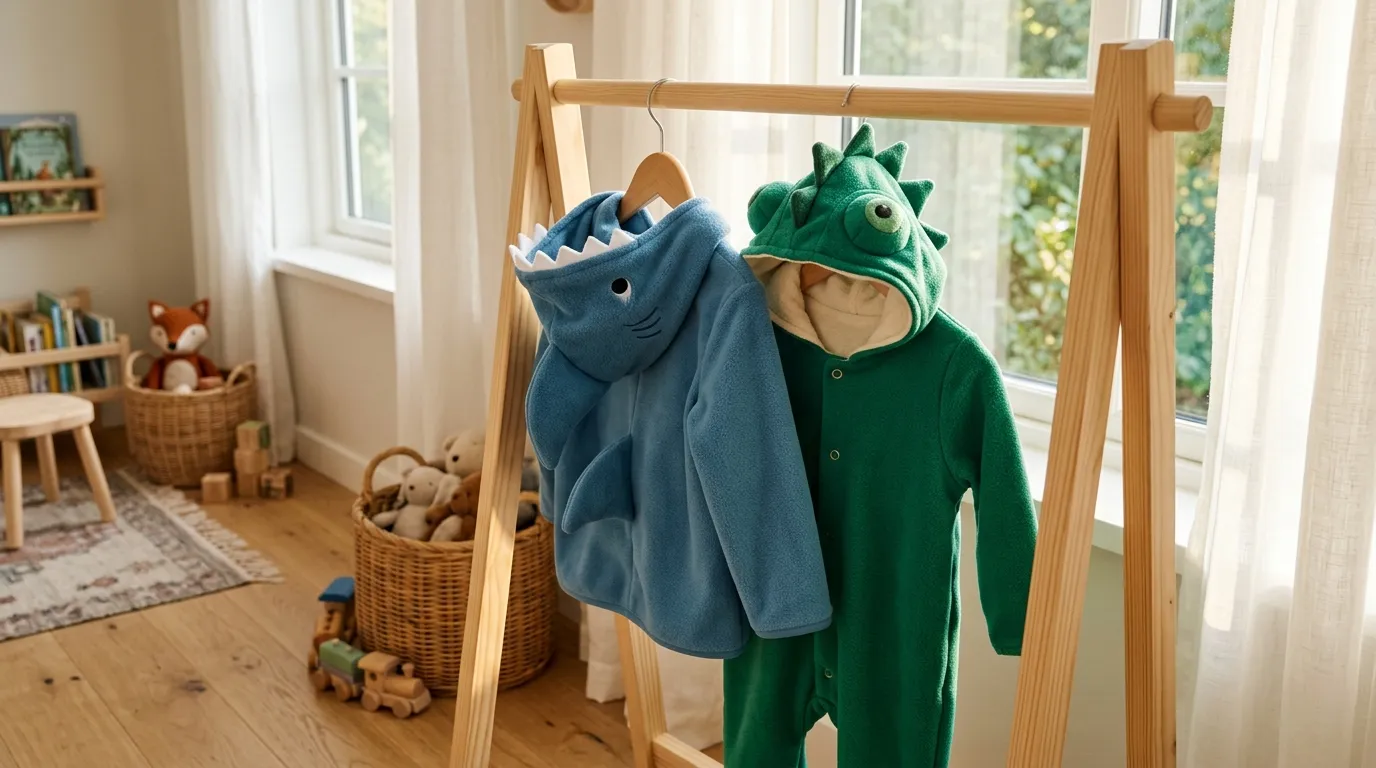
Toddlers are rapidly building their first vocabulary bank and transitioning from single words to short phrases. Ultra-soft, easy-on pieces like the personalized white fleece bunny onesie, the green polar fleece chameleon jumpsuit, the spotted blue monster hooded set, and the blue fleece ocean octopus hoodie offer immediate visual and tactile cues.
- How to Play (The +1 Expansion Technique): When your toddler hops in their bunny onesie and says "Bunny hop!", validate their phrase and add one or two descriptive words: "Yes! The fluffy white bunny hops high onto the green pillow!"
- Target Language: Playful sound effects (zoom, splash, hop, roar), action verbs (climbing, hiding, swimming, sleeping), and spatial prepositions (inside the tent, under the bridge, on top).
3 – 5 Years (Preschool): "Why & How" Problem-Solving and Specialized Vocabulary
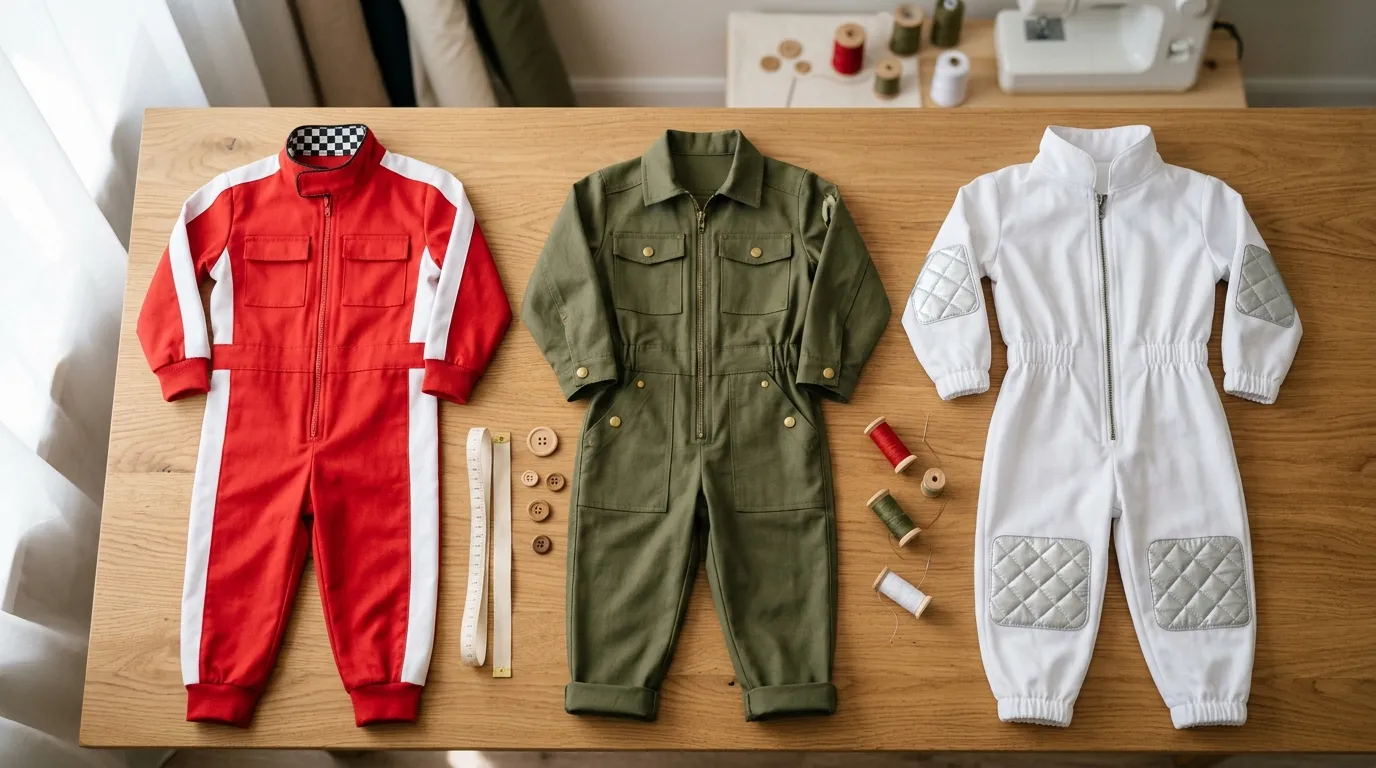
Preschoolers are ready for multi-turn dialogues and imaginative problem-solving. Authentic, personalized outfits like the long-sleeve white astronaut jumpsuit, the olive green long-sleeve pilot jumpsuit, the red long-sleeve race car jumpsuit, and the personalized green police officer uniform inspire rich role-play scenarios.
- How to Play (Open-Ended Mission Dilemmas): Replace yes/no questions ("Is your rocket fast?") with open-ended prompts that invite explanation: "Captain Pilot, our radar shows a thick snowstorm ahead of the runway! How should we guide the airplane safely to the ground, and what supplies do the passengers need?"
- Target Language: Cause-and-effect connectors (because, so that, if, before, after), emotional vocabulary (focused, relieved, curious, brave), and technical role words.
5 – 7 Years: Multi-Character Storytelling, Interviews, and Perspective-Taking
Kindergarten and early elementary children love directing full plots, inventing rules, and shifting perspectives. Outfits like the black race car jumpsuit with reflective strips, the hologram sequin octopus hoodie, the white and navy nautical sailor costume, and the handmade fleece gamer hoodie let older kids host mock nature documentaries, post-race press conferences, or radio broadcasts.
- How to Play (The Live Reporter Interview): Hold a wooden spoon like a microphone and interview your child in character: "We are live at the finish line with Champion Racer Maya! Tell our listeners how you navigated that slippery final corner when your tires lost grip!"
Costume Theme Vocabulary Basket & Dialogue Prompt Table
Use this quick reference table to sprinkle rich tier-2 vocabulary and open-ended prompts into your child's favorite dress-up themes:
| Costume Theme | Featured Tiny Trail Kids Outfit | Rich Vocabulary Basket to Introduce | Open-Ended Parent Dialogue Starter |
|---|---|---|---|
| Space & Astronomy | Long or Short-Sleeve White Astronaut Suit | Orbit, gravity, crater, capsule, weightless, constellation, explore, luminous | "Commander, what does the surface of this newly discovered planet look and feel like?" |
| Aviation & Flight | Olive Green Pilot Jumpsuit or Aviator Dress | Cockpit, altitude, compass, horizon, turbulence, navigate, runway, destination | "Captain, when you look down through the clouds, what landmarks do you spot below?" |
| Racing & Engineering | Red, White, or Black Race Car Jumpsuit | Pit-stop, traction, accelerate, curve, inspect, repair, durable, teamwork | "Chief Mechanic, what adjustment should we make in the pit lane so the car corners smoothly?" |
| Ocean & Maritime | Octopus / Shark Hoodie or Sailor Dress | Coral reef, tentacle, dorsal fin, current, submarine, shimmer, shallow, protect | "Little Octopus, what treasures are each of your eight arms helping you gather on the reef?" |
| Woodland & Nature | Fleece Chameleon, White Bunny, Fox Tutu | Camouflage, burrow, rustle, trail, forage, cozy, gentle, season | "Clever Chameleon, why did you choose to blend into that bright green leaf today?" |

5 Interactive Costume Games That Spark Expressive Speech at Home
Try any of these five 15-minute games after dinner or on weekend mornings to turn dress-up time into an engaging language workout:
1. Walkie-Talkie Mystery Object Description
When your child wears their white astronaut space suit or pilot uniform, hand them a cardboard tube "walkie-talkie" and sit across the room. Place five everyday items in a basket beside them. Their mission is to describe each "alien artifact" over the radio using only adjectives—shape, color, texture, and function—without naming it ("Control Tower, I found something round, bumpy, orange, and juicy!"). This game builds descriptive precision rapidly.
2. Storybook Page-Freeze & Director's Cut
Pair a favorite picture book with a matching outfit—such as the orange fox tutu skirt and vest for a woodland tale or the blue shark fin hoodie for an ocean adventure. Pause right before the story's climax and say: "You are the fox in this story now! What happens next, and what do you say to the bear?" Acting out alternative endings strengthens narrative sequencing and verbal creativity.
3. Sensory Comfort & Emotion Check-In
Children speak most expressively when their bodies feel calm and comfortable. Scratchy seams, stiff synthetic fabrics, or tight collars create sensory distraction that cuts pretend play short. When your child snuggles into a soft purple fleece chameleon jumpsuit, explore both tactile words (plush, velvety, warm, smooth, stretchy) and emotional words (peaceful, proud, excited, brave).
4. Bilingual Flight Passport Game
If your family is introducing a second language, costume play removes the pressure of formal drills. When your child wears the green aviator dress or sailor outfit, stamp a paper passport as they "land" in different rooms and practice greetings, colors, counting, and weather words in the target language as part of the flight checklist.
5. The "Silly Mixed-Up Parent" Game
Nothing motivates a young child to speak in full, logical sentences faster than correcting a playfully confused adult! While your child is wearing their white short-sleeve race car costume, ask with a straight face: "Excuse me, Chef! Are you going to bake soup inside your race car tires today, or fly your car underwater?" Your child will gleefully burst into a detailed explanation of what race car drivers actually do, practicing negation, vocabulary, and reasoning all at once.
4 Common Mistakes to Avoid When Supporting Language Through Play
- Turning pretend play into a quiz show: Firing rapid test questions ("What color is that? How many buttons? Say astronaut!") shuts down creative flow. Follow the 4-to-1 rule: make four supportive in-character observations for every one open-ended question you ask.
- Interrupting the story to correct pronunciation: If your child mispronounces a sound while excitedly describing their space mission, do not stop the action to demand a repeat. Simply model the word naturally in your enthusiastic reply: "Wow, your astronaut telescope spotted three rings around Saturn!"
- Rushing to finish your child's sentences: When a child pauses to search for a big word, wait patiently with warm eye contact for a full five seconds. That quiet processing pause gives their brain the space to retrieve and assemble the sentence independently.
- Taking over as the director: Let your child lead the plot while you play the curious assistant who enriches the scene with vivid words.
Frequently Asked Questions
Can dress-up costumes help late talkers or toddlers who feel shy speaking?
Yes—costumes provide a concrete visual and tactile anchor for communication. A toddler who hesitates to answer abstract questions often lights up when roaring as a friendly monster, hopping in a bunny onesie, or revving a race car engine. Starting with playful sound effects and physical gestures in costume builds the joyful momentum that leads into two- and three-word phrases.
Does custom name embroidery on a costume support early literacy?
Absolutely. Seeing their own name stitched across the chest of a beloved astronaut, pilot, or race car jumpsuit is one of the most powerful early sparks for print awareness. Children love tracing the satin-stitched letters with their fingers, recognizing their first initial, and proudly reading their nameplate to family members.
Which costume themes encourage the richest back-and-forth conversation?
Combining one cozy animal costume (chameleon, bunny, fox, octopus, shark) with one community or explorer uniform (astronaut, pilot, racer, police officer, sailor) covers every linguistic base. Animal outfits excel at sensory descriptions, empathy, and nature stories, while explorer uniforms naturally invite walkie-talkie dialogues, mission planning, and cooperative problem-solving.
Why does fabric comfort matter for speech and pretend play duration?
Young children have limited sensory bandwidth. If an outfit is stiff, itchy, or traps heat, a large portion of the child's attention goes toward physical discomfort, causing them to pull the costume off after five minutes. Breathable cotton twill and soft polar fleece allow children to forget what they are wearing physically so they can stay immersed in rich verbal storytelling for an hour or more.
How many minutes of costumed role-play per day make a difference?
Just 15 to 20 minutes of screen-free, face-to-face pretend play a few times a week creates a measurable boost in vocabulary retention and narrative confidence. Once you help launch the dialogue for fifteen minutes, children frequently continue narrating the adventure on their own.
How do sibling or peer costume games strengthen social communication?
Group dress-up play requires children to negotiate roles, explain invisible rules to a peer, listen to someone else's idea, and compromise on plot twists—giving pragmatic social language its best possible real-world rehearsal.
Every Stitch Holds a Story Waiting to Be Told
When you give a child a comfortable, thoughtfully crafted costume and step into their imaginary world as an enthusiastic listener, every afternoon becomes an adventure in language and connection. Browse our full collection of breathable cotton and plush polar designs on the Tiny Trail Kids products page, explore more developmental play guides on the Tiny Trail Kids blog, or reach out anytime via our Contact page.